TRaC Baseline Study for PASSR II - Contraceptive Use in Northern and East Cameroon
The TRaC baseline study for PASSR II establishes the evidence base needed to strengthen family planning services across Cameroon’s Northern and East regions. Sponsored by KfW and implemented by EVIHDAF, PSI Cameroon and ACMS, the study measures knowledge, attitudes, and use of modern contraceptive methods among women, men, and youth to guide program design and scale‑up. Data will be collected from mid-March to mid-April 2026.
Background
Sexual and reproductive health remains a critical public health priority in Cameroon. According to the 2018 Demographic and Health Survey (DHS), the maternal mortality ratio is 406 deaths per 100,000 live births, and modern contraceptive prevalence stagnates at 15.4% among women of reproductive age, while unmet needs have increased to reach 23%. This situation is exacerbated by strong regional disparities: the Northern regions (Adamaoua, North, Far-North) and the East display the lowest indicators, with prevalence dropping to between 6% and 7%. To address this, the government and KfW launched the Reproductive Health Services Access Program (PASSR). Following a first phase that increased knowledge of methods through the ProFam social franchise network, Phase II (PASSR II) aims to consolidate these achievements. This new phase innovates by expanding its target populations to include men and youth to holistically address sociocultural barriers.
Study Objectives
General objective
The overall objective of the study is to establish baseline values for the key indicators of the Reproductive Health Services Access Program (PASSR II) in the Far North, North, Adamaoua and East regions, in order to enable monitoring of the program’s progress and to serve as a reference for Phase III.
Specific objectives
- Produce baseline values for all PASSR II key indicators, disaggregated by region, residence (urban/rural) and target group.
- Identify the most vulnerable subgroups of the population in terms of knowledge, access to and use of contraceptive methods, as well as menstrual hygiene among children, pre‑adolescents and youth, to prioritize interventions.
- Analyze determinants and perceived barriers associated with use of family planning services, highlighting differences between adult women, children/pre‑adolescents and youth, and men.
- Formulate concrete operational recommendations to calibrate and target strategies, including their innovative components.
Study design and methods
The study adopts a cross-sectional quantitative design across the 56 intervention health districts. The target population consists of women and girls (10-49 years), and men and boys (10-59 years). Sampling relies on a three-stage stratified random design (28 districts, 67 health areas, and 30 households per cluster), to reach a total of 2,010 households. This sample size was specifically calculated to detect a 5%-point increase in modern contraceptive prevalence, with 80% statistical power. In compliance with ethical requirements, all areas classified as active security crisis zones (red zones) were excluded from the sampling frame prior to the draw. Data collection will be conducted by 18 enumerators organized into six teams of three (two women, one man), a mixed composition that is crucial for respecting gender sensitivities (men interviewing men, women interviewing women). They will administer three types of questionnaires (Household, Woman, Man) on tablets using KoboCollect. To ensure complete anonymity, no names will be collected; participants will be identified solely by unique codes generated by the application. Data processing will be performed using R and analysis using Stata. Furthermore, a document review will be conducted and data triangulation undertaken to better contextualize the results.
Expected outputs and use of findings
- Baseline indicator disaggregated by region, residence, and target group.
- Operational recommendations to optimize PASSR II interventions and inform Phase III planning.
- Dissemination of findings with MINSANTE, implementing partners, and local stakeholders to support evidence‑based decision making.
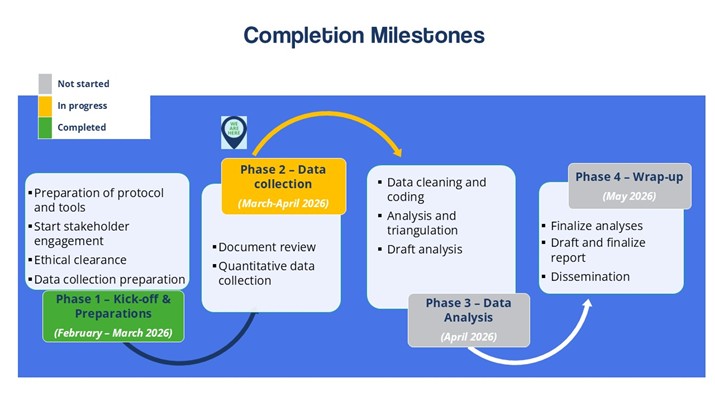
Snapshot
Study area : Cameroon (East, Adamaoua, North and Far-North regions)
Duration: February – May 2026
Partners:
EVIHDAF, PSI Cameroon, ACMS, DSF/MINSANTE
Funder: KFW
Others Projects
Projects Activities
Publications
Project Outcomes
Publications
No downloads found!
Project Outcomes
Coming Soon ….

Close up of young patient receiving bottle of pills from doctor